
The 7-Day Trading Starter Course
Learn the real game before the market plays you.
Welcome to your crash course in trading — no hype, no fake gurus, no “get rich quick.”
Just clear, practical lessons that help you understand how the market really works.
Each day builds on the last, so by the end you’ll know how to trade smarter, stay calm under pressure, and avoid the traps that wipe out beginners.
💡 What You’ll Learn
- How trading actually works — no fancy words, just reality.
- How to open your first account safely.
- What charts, indicators, and news really mean.
- How to protect your capital like a pro.
- How to stay sane while everyone else panics.
⚡ The Course Structure
Day 1 – What the Heck Is Trading Anyway?
Understand what trading really is, how markets behave, and why no one can fully predict them.
Day 2 – Setting Up: Brokers, Accounts & Staying Safe
Learn how to choose the right platform, avoid scams, and handle your first crypto account like a pro.
Day 3 – Technical Analysis Basics
Discover what charts, candles, and trends actually tell you — and how to spot good setups.
Day 4 – Why the Market Freaks Out
Understand the “fundamentals” — news, sentiment, whales, and hidden market mechanics.
Day 5 – Orders, Stops & Risk Management
Master the boring (but essential) part: staying alive. Learn to set proper stop-loss and take-profit levels.
Day 6 – Indicators: Tools, Traps, and How to Use Them Right
RSI, Moving Averages, Bollinger Bands — simple tools explained without the math headache.
Day 7 – The Trader’s Mindset
Learn the psychology of trading — discipline, patience, emotional control — the real edge behind success.
⚠️ Disclaimer
This course is for educational purposes only.
Trading involves risk. You can lose money.
Always think in probabilities, not certainties — and never trade with money you can’t afford to lose.

▶ Start the Course
Begin with Day 1 → “What the Heck Is Trading Anyway?”
Use the navigation below each page to move between lessons:
[Previous] [Next] [Progress ▰▰▰▰▱▱▱ 60%]
Ad
Join Binance today and start trading!
One of the world’s largest crypto platforms, offering low fees and a wide selection of coins to trade.
BTC Live Price (USDT)
Day 1 – What the Heck Is Trading Anyway?
Welcome aboard.
Today isn’t about turning you into a millionaire overnight — it’s about understanding what trading really is, why people do it, and how not to become one of those memes of someone crying over a chart at 3 a.m.
Grab a drink, relax, and let’s untangle the mystery.
What Is Trading, Really?
Trading means buying and selling assets — crypto, stocks, currencies — trying to profit from price changes.
It’s basically surfing waves of human emotion.
You don’t create the wave, you don’t control the ocean, you just learn to ride it without face-planting.
Every candle on a chart is a mini war between buyers and sellers. You’re stepping into that battlefield, not as a gambler, but as someone trying to understand how people behave when money’s on the line.

Why Do Prices Even Move?
Prices move because people disagree.
One trader thinks Bitcoin is going to the moon; another thinks it’s heading to the basement.
Their trades clash, and that push-and-pull creates movement — that’s the market breathing.
It’s not magic. It’s psychology, supply and demand, and a sprinkle of chaos.
The Different Kinds of Markets
Let’s break it down without the Wall Street vocabulary.
- Spot Market – The “what you see is what you get” version. You buy the real thing (BTC, ETH, etc.).
- Futures Market – You trade contracts about the future price. No real Bitcoin here, just paper promises — with leverage, which can multiply bothgains and pain.
- Derivatives – Think of these as the exotic dishes on the menu: complex, spicy, and not beginner-friendly. Delicious for pros, disastrous for rookies.
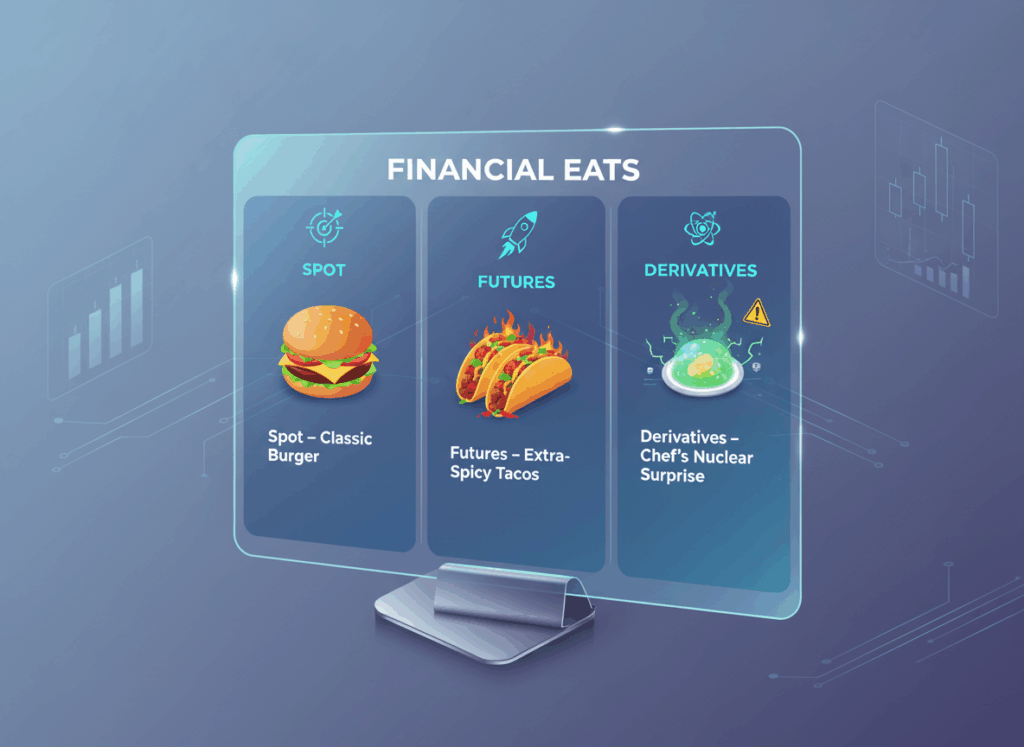
Note: Futures are technically a type of derivative. Derivatives can include futures, options, swaps, and other contracts. Here they’re shown separately only to keep the menu-style analogy clear and fun.
Essential Concepts to Know Before You Dive In
Liquidity
Liquidity measures how easy it is to buy or sell something.
In a busy market, trades happen instantly — like selling water in the desert.
In a dead market, your order just sits there, collecting dust.
Volatility
Volatility is how wild the price swings.
Imagine a calm lake (low volatility) versus a stormy ocean (high volatility).
Some traders love the storm; others drown in it.
Spread
That little gap between the buy and sell price? That’s the spread, and brokers live off it.
It’s like paying a small toll every time you enter or exit a trade — annoying, but part of the road.
Fees
Ah yes, the silent killer of profits.
Every trade, withdrawal, or even deposit can come with a hidden fee.
Later we’ll see how to spot and avoid them before they nibble away your gains.
Trading ≠ Science (and That’s Okay)
Let’s get this straight: there’s no magic formula.
Charts, indicators, and fancy strategies help, but they don’t predict the future — they just stack the odds a little in your favor.
Trading is more about probabilities and discipline than about being “right”.
Think like a poker player, not a fortune-teller: you can lose a hand and still win the night.

Why People Lose (and What Smart Ones Do Differently)
Most beginners:
- Jump in without a plan
- Trade because of hype or boredom
- Refuse to accept losses
Smart traders:
- Respect risk
- Think in probabilities
- Keep emotions out of the driver’s seat
That’s the mindset we’ll build across these seven days.
Your Mission Today
Before moving to Day 2, take a few minutes to think:
- Why do you want to trade? Freedom, curiosity, or quick money?
- How much are you ready to risk to learn?
- Could you stay calm while losing a trade, or would you rage-quit?
Write your answers somewhere — you’ll be surprised how they evolve later.

Tomorrow, we’ll explore how to set up your first account, stay safe, and avoid the traps that swallow newbies faster than a liquidation wick.
Next: Setting Up Your Trading Account